09 December 2025
The Difference Between NGOs, NPOs, & Charitable Organizations in South Africa
- Share on
-

-

-


When we talk about the challenges and the incredible potential of South Africa, we often overlook the main reason: the nonprofit sector. These organizations are the functional safety net, the very definition of resilience.
Every single day, they are delivering life-changing necessities—from securing free meals to children in disadvantaged areas and fighting for reliable healthcare for families, to funding essential, transformative educational programmes for youth.
This massive, complex field is fundamentally organized around three legal entities: the NPOs in South Africa, the NGOs in South Africa, and the charities in South Africa.
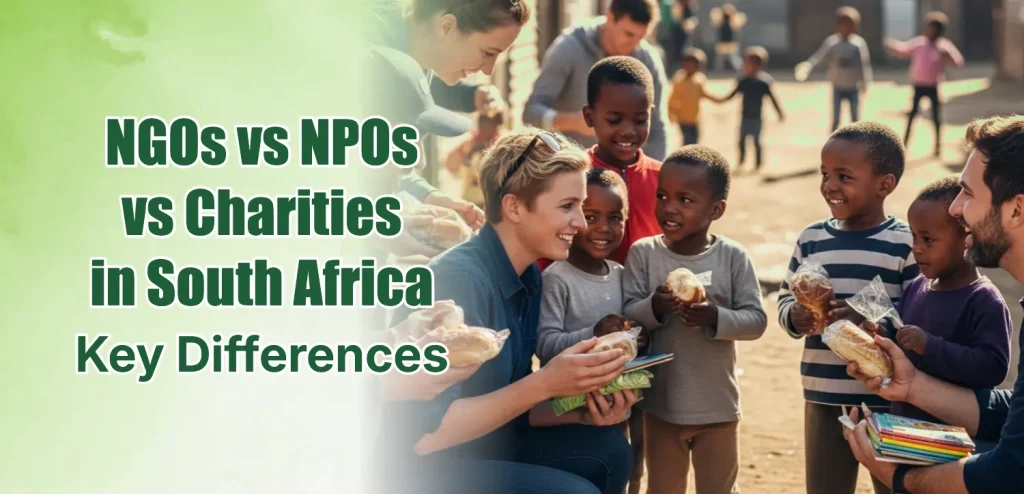
NGOs vs NPOs vs Charities in South Africa: Key Differences
It’s absolutely vital we stop treating these terms as interchangeable. They are not. Each has a profoundly different legal structure, operational scope, funding dependency, and philosophy on how to generate lasting impact.
For anyone dedicating resources—whether you are a grant-maker, a corporate partner, or an individual volunteer—mastering these distinctions is the baseline requirement.
It’s the only way to move beyond good intentions and make a genuinely informed decision that ensures your effort yields the maximum possible social return.
NPOs in South Africa: The Unwavering Community Anchor
Think of the Nonprofit Organization (NPO) in South Africa as the most reliable, constant force in a neighborhood.
It’s a registered entity designed to run structured programmes aimed at consistently and tangibly improving the lives of a specific, local community.
Their entire success model is built on their proximity, operating within a town, a district, or a province. The greatest asset of an NPO is its commitment to remaining a trusted, permanent fixture.
What NPOs Actually Build and Sustain
NPOs deliberately focus on the long-term, foundational improvements that steadily raise the community’s quality of life. Their projects are defined by consistency:
- Feeding Programmes: These are not ad-hoc donations. They are reliable, daily meals for schoolchildren. This simple, consistent act is a powerful strategic tool that both combats hunger and is proven to significantly boost school attendance and academic performance.
- Education Support: They offer sustained academic scaffolding: free tutoring, dedicated after-school study centres, or running specific scholarship programmes that genuinely open doors to better opportunities for marginalized youth.
- Healthcare Initiatives: They bring services to the people, leading preventative health awareness drives right where the community gathers.
- Skills Development: They are the practical job creators, equipping adults and youth with vocational training so they can secure stable work or launch independent small businesses.
The trust that NPOs in South Africa have earned is their currency. Families who rely on a consistent health clinic or children who depend on a daily meal know they can count on this constancy.
Their funding strategy mirrors this stability, combining government grants, steady corporate social investment (CSI) budgets, and reliable community donations. Sustained funding is simply non-negotiable for their existence.
NGOs in South Africa: The Force for Systemic Reform
When the challenge is national—a breakdown in policy, vast infrastructure gaps, or widespread systemic poverty—you are looking at the Non-Governmental Organization, or NGO in South Africa.
These organizations are designed for large-scale systemic intervention, often operating across multiple provinces or globally, which requires major financial backing from international foundations and global donors.
NGOs: Targeting the Root Causes
NGOs like Narayan Seva Sansthan are engineered to attack broad, societal fault lines, operating with intense administrative rigor and focusing on ambitious, measurable, long-term objectives. Their strategic portfolio includes:
- Healthcare Access: They act as system reformers, working structurally to improve the efficiency, quality, and geographical reach of health infrastructure across entire, vast regions.
- Educational Outreach: They implement large-scale interventions, standardized teacher training programmes, and the coordination of mass distribution of educational materials to children.
- Poverty Alleviation: They launch complex national programmes that strategically weave together solutions: linking financial literacy education and the establishment of broad social safety nets.
The national scope of NGO organizations in South Africa requires sophisticated, transparent governance and professional teams capable of managing intricate, multi-regional projects.
They are highly scrutinized for their measurable impact on a national scale and their long-term viability. Their funding—relying on major national and international grants—allows them to undertake huge, capital-intensive projects that smaller, local NPOs could never finance.
Charities in South Africa: The Immediate Lifeline
Charities in South Africa are the emergency response teams. Their sole, unwavering focus is providing urgent, practical support during times of acute and immediate need. They are the quick-reaction force, operating deep in the community to deliver swift relief.
The Quick, Concrete Relief Charities Offer
Charities excel at rapid, decisive, and tangible interventions:
- Food Assistance: Organizing immediate, life-saving distribution of prepared meals, water, or food parcels to families.
- Educational Support: Providing direct, concrete assistance: securing uniforms, textbooks, or covering fees for emergency extra lessons to prevent a child from dropping out.
- Healthcare: Offering immediate emergency medical aid, rapidly deploying mobile clinics, or distributing critical medical supplies.
The efficiency of charities in South Africa stems from their deep, organic community connections. While many intelligently choose to register formally as NPOs for legitimacy, their operational tempo is driven by necessity.
Their funding is the most personal, sourced from local individual donations, grassroots fundraising events, and targeted support from SA charity organisations and other charitable organisations in South Africa.
This immediate financial pipeline allows them to bypass bureaucratic delays and deliver aid precisely where the crisis is unfolding.
Making Your Contribution Matter
When committing resources, you must align your specific goal with the organization’s structure. It’s a strategic decision:
| Organisation Type | Primary Mandate | Your Ideal Investment Focus |
|---|---|---|
| NPOs | Sustained, consistent local improvement. | Long-term investment in community stability and growth. |
| NGOs | Large-scale systemic change and policy influence. | Funding broad, structural, and national reform. |
| Charities | Immediate, hands-on, crisis intervention. | Swift, direct delivery of urgent humanitarian assistance. |
Matching your philanthropic resources—whether it’s specialized skills, dedicated time, or financial capital—to the appropriate structure is the most effective guarantee that your efforts translate into the highest possible impact.
Conclusion
Supporting an NPO in South Africa, partnering with an NGO in South Africa, or donating to a charity in South Africa is foundational to building a more equitable and resilient society.
Each entity is absolutely critical, playing a unique, irreplaceable role.
By understanding these distinctions, we empower ourselves to contribute intelligently, ensuring our collective resources effectively reach the communities that most desperately need improved access to education, healthcare, and essential services.